
Rapid Prototyping China
Rapid Prototyping China — 100+ machines in Dongguan, 3/7/30-day tiers. Tolerances: ±0.003 mm milling, ±0.002 mm turning — ISO 9001 / IATF 16949 verified.
Rapid prototyping in China is a queueing problem: capacity shortens the lead time. This page covers how capacity works, the prototype-to-production ramp, and what slows a date down.
What is rapid prototyping in China?
Rapid prototyping in China is fast prototype manufacturing from a Chinese plant — this one in Dongguan with 100+ machines and 3/7/30-day tiers. Lead time is a queueing problem: capacity decides how fast a job jumps the queue.
Every feature that needs a separate operation adds a step: a secondary side, a thread, a finish, a heat treatment. Each step adds both setup time and queue time, so complexity compounds. A part with ten operations is not ten times slower than one with one operation — it is slower by more, because each handoff between operations is a place where the part can wait.
There is a second-order cost too. Every re-clamping introduces a locating error, so a part with many setups needs tighter in-process control just to hold the same print. The critical path — the longest chain of dependent operations — grows longer, and the whole schedule rides on it. The fastest way to shorten a lead time is therefore a design review that removes unnecessary steps before the first cut.
How does capacity shorten your lead time?
Capacity is what lets a prototype jump the queue. In queueing terms, a single machine running near full utilization produces wait times that grow sharply — a job that arrives behind two others can wait as long as both. Parallel capacity changes the arithmetic: a job routes to the first open machine that fits it, so it waits for the next available slot, not for a specific machine to finish.
With more than 100 machines on the floor, the queue stays short because the machines are deep in every process. A small shop queues its work; a real plant schedules it. That distinction — not the headline machine count — is what separates a prototype that ships from one that slips.
| Machine type | Count | What it does for the schedule |
|---|---|---|
| 3-axis milling | 50+ | Deep parallel capacity for simple parts — the ~3-day tier |
| 4-axis milling | 20+ | Fewer setups on multi-face parts |
| 5-axis milling | 20+ | Complex geometry in fewer setups |
| CNC lathes | 25+ | Round parts that do not queue behind milling |
| Grinders | 7+ | Finish passes at ±0.002 mm |
How do you plan a prototyping-to-production ramp?
Plan the ramp as three phases on one floor: prototype at the MOQ of 1 piece to validate the design, pilot at low volume to confirm the process, then production at volume where setup cost amortizes. The point of the sequence is that each phase de-risks the next before you commit spend to it.
Because the same plant and the same machines run all three, the process that validated your prototype is the process that scales. There is no re-qualification and no re-learning the part at a new supplier — two things that quietly add weeks to a ramp and erase whatever the prototype saved you.
A ramp also needs capacity reserved in advance, not discovered at the last minute. The pilot volume and the production volume are two different loads on the floor, and a supplier that knows your trajectory can hold the machine time for the phase that is coming. Tell the shop the shape of the ramp — one piece now, fifty next month, five thousand the month after — and it can match the floor to the curve instead of reacting to each order as it lands.
What slows a lead time down?
Three things slow a part, and all three are knowable before you send the file. Surface finishing — anodizing, plating, or coating — adds a process step and pushes a part toward the 30-day tier. Heat treatment — stress relief or hardening — adds cycle time and often a second straightening step. Design changes mid-order restart the clock, because a revised part re-enters programming, setup, and queue.
- Surface finishing moves the part off the floor to an outside process and back, which adds a whole leg of queue time.
- Heat treatment changes the part before finish machining, so the schedule has to absorb a thermal cycle in the middle of it.
- Mid-order changes are the most expensive of the three, because they discard work already cut and re-enter every step that came before.
Stating finish and heat treatment in the RFQ — and freezing the drawing before release — is how you keep a schedule honest.
How do you get a part fast without sacrificing quality?
Speed and quality are not in conflict — they are both decided by the same thing: a process under control. A part that holds tolerance on the first pass ships fast; a part that scraps and reworks ships slow, because rework is a second pass through the same schedule.
Here, the SPC record shows Cpk = 1.851 (one characteristic on one part, not a blanket capability claim) against an initial-study target of Ppk ≥ 1.67, on a representative length characteristic of 76.1–76.5 mm. That number is what fast-and-right looks like measured rather than promised: the process is capable enough that most parts pass on the first pass, so the schedule does not have to absorb rework.
Start with the tolerance band, not the capability number. Cpk compares the band to the process spread — it is a ratio, not a badge of accuracy. The recorded example sat on a 0.4 mm length band (76.1–76.5 mm) with Cpk 1.851, which is wide by design. Push that same spread onto a ±0.005 mm feature and it would fail outright. Always ask a supplier for the band, the subgroup size and the window behind any Cpk figure.
How do you plan capacity around a launch?
Tell the shop your target date and your volume trajectory, and it will tell you honestly whether the schedule holds, not the other way around. A launch is a ramp, and a ramp is a capacity question: can the floor absorb your pilot volume without pushing your production volume behind other work.
With a hundred-odd machines and the MOQ of 1 piece, a launch can start at a single prototype and scale without re-sourcing. Planning capacity around a launch means matching the ramp to the floor, so the deadline is a plan matched to real machine availability, not a hope.
How does setup count map to the tiers?
Setups are the cleanest predictor of which tier a part falls into, because every setup is a handoff, and every handoff is queue time. Count the setups and you can estimate the tier before a single machine runs.
| Setup count | Typical tier | What it means |
|---|---|---|
| 1 setup, no finishing | ~3 days | The part never leaves the first clamping |
| 2–4 setups | ~7 days | Multiple faces, standard tolerances |
| 5+ setups, or finishing / heat treat | ~30 days | Long critical path plus outside steps |
your lever is design: a part that can be made in two setups instead of four drops a tier. The supplier's lever is routing: a part that moves between machines on one floor drops less queue than one that moves between vendors. Both levers are visible in the quote if you know to look for them.
How do tolerances change the schedule?
A tolerance is a speed instruction hidden in the drawing. A loose callout machines in one pass and needs no special handling. A tight callout forces a slower process and a verification step. Every tightening you add is time you add, so tolerances should be called out only where the function needs them.
| Tolerance callout | Process that holds it | What it adds to the schedule |
|---|---|---|
| ISO 2768-m general | Milling / turning, single pass | No extra step — stays in the ~3-day tier |
| Tight — ±0.003 mm (milling) / ±0.002 mm (turning) | Milling / turning, verified | CMM check on critical dimensions |
| Tightest — ±0.002 mm | Precision grinding | Extra setup and a finish pass |
ISO 2768 is the baseline to reference. Its linear tolerances are graded f (fine), m (medium), c (coarse), and v (very coarse); a part drawn to ISO 2768-m and machined to ±0.003 mm (milling) / ±0.002 mm (turning) only on the dimensions that matter is a part that ships fast and still fits. Draw every dimension tight and the whole part moves to a slower tier for no functional gain.
The numbers are worth holding in your head. Under ISO 2768-1, a dimension from 6 to 30 mm carries ±0.2 mm at grade m and ±0.1 mm at grade f; from 30 to 120 mm it is ±0.3 mm at m and ±0.15 mm at f; from 120 to 400 mm it is ±0.5 mm at m and ±0.2 mm at f. Those are the "leave it alone" tolerances. The machining floor here holds ±0.003 mm (milling) / ±0.002 mm (turning) where a dimension genuinely needs it, which means the drawing stays loose everywhere it can and tight only where function demands, and that is precisely what keeps the schedule in the faster tiers.
How does surface finish push a part to the 30-day tier?
Surface finish is where schedules quietly die, because finish is an outside step. A machined finish stays on the floor and stays in the shorter tiers. An anodize, plate, or coat sends the part to an outside process and back — a round trip that adds days of queue time on top of the machining.
| Finish | Typical process | Schedule effect |
|---|---|---|
| Machined, Ra 3.2 µm | Milling / turning as-cut | No extra step |
| Machined, Ra 1.6 µm | Fine feed or light pass | Minor, stays on the floor |
| Machined, Ra 0.8 µm | Grinding or careful finishing | Adds a finishing pass |
| Anodize / plate / coat | Outside surface treatment | Moves to the ~30-day tier |
The planning discipline is to call out finish only where the part needs it. A functional surface that contacts a seal may need Ra 0.8 µm; a cosmetic face often does not. Every finish you can drop keeps the part in a faster tier.
Deep dive: what tolerances and surface finishes a China prototyping shop can realistically hold, feature by feature.
How does material choice affect the schedule?
Material sets cutting speed and tool wear, and both become machine time. Aluminum cuts fast and wears tools slowly. Stainless steel and alloy steel cut slower and wear tools faster, so the same geometry costs more machining time in 304 than in 6061-T6. Material also decides whether heat treatment sits in the middle of your schedule.
| Material | Machinability vs aluminum | Typical prototype use |
|---|---|---|
| 6061-T6 aluminum | Reference — cuts fast | Housings, brackets, general parts |
| 7075-T6 aluminum | Slightly slower | Parts needing more strength per gram |
| 5052 aluminum | Fast | Sheet-like parts, corrosion resistance |
| 304 stainless | Noticeably slower | Corrosion and food-contact parts |
| 316 stainless | Noticeably slower | Marine and chemical environments |
| 4140 alloy steel | Slow, then heat treat | High-strength shafts and fasteners |
The practical question is not "which metal is best" but "which metal meets the function at the lowest schedule cost." 6061-T6 is the default for a reason: it machines fast, anodizes well, and covers most prototypes. Save 7075-T6 for strength, 316 for corrosion, and 4140 for parts that will be hardened, and accept the added machine time each one carries.
Deeper dive: Aluminum vs stainless steel for rapid prototyping — the two metals that anchor the schedule comparison, mapped to the tiers with a decision table.
How does DFM shorten the critical path?
Design for manufacturability is the highest-leverage lead-time work you can do, because it happens before any machine runs. A few practical rules remove whole operations from the critical path:
- Internal radii should be at least a third of the pocket depth — a sharp inside corner forces a smaller, slower tool and a finish pass.
- Hole depth should stay under about four to five diameters for a standard drill — deeper holes need pecking or gun drilling, which adds cycle time.
- Wall thickness should be thick enough not to deflect under cutting force — a thin wall chatters, and chatter means slower feeds and a scrap risk.
- Threads should be on an accessible axis — a thread on a hard-to-reach face forces an extra setup.
- Finishes and tolerances should be marked only where needed — every extra one is a step on the critical path.
A DFM review that turns five setups into three and drops an unnecessary finish can move a part down a whole tier. That is lead time recovered for the price of a drawing change, which is the cheapest time you will ever buy.
How do you scope a part for the 3-day tier?
The 3-day tier is not a marketing bucket — it has real boundary conditions. A part stays in it when it needs one setup, one material, standard tolerances, and no finishing. Meet those four and the date is a real three days, not an aspiration.
- One setup: all features reachable from a single clamping, or a turned part done in one chucking.
- One material: no bonding, no insert, no secondary assembly in the schedule.
- Standard tolerances: ISO 2768-m general, with ±0.003 mm (milling) / ±0.002 mm (turning) only on the few dimensions that need it.
- No finishing: machined-only surfaces, no anodize, plate, coat, or heat treat.
If your part needs a second side, a thread on a hidden face, or a finish, it moves to ~7 days or ~30 days, not because the shop is slow, but because the part genuinely has more steps. Knowing the boundary lets you design toward the faster tier when the launch date demands it.
How do mill-turn and 5-axis cut setups and lead time?
Setup count is the schedule cost you can design away with the right machine. Mill-turn does turned and milled features in one clamping, removing the handoff between a lathe and a mill — a step, a queue, and a locating error all gone at once. Five-axis milling reaches multiple faces without re-clamping, so a part that would need four setups on a 3-axis machine needs fewer on a 5-axis.
The economics are simple: every setup removed is queue time removed and locating error removed. On Mazak and Brother class centers holding ±0.003 mm (milling) / ±0.002 mm (turning), a part with turned and milled features is done in one clamping, which shortens the lead time by removing a whole operation from the critical path. The machine costs more per hour, but the schedule and the scrap risk both shrink, which is usually the trade a prototype wants.
What does "capacity" actually mean on a factory floor?
Capacity is not the machine count on a slide — it is the ability to schedule a new job without stalling the ones already running. Two factories can both own 80 machines and have wildly different lead times, because the number that matters is the count of the right machine type that is open when your job arrives.
Deep per-process capacity is the difference. Fifty-plus 3-axis mills do nothing for a job that needs a lathe; 25+ lathes do nothing for a job that needs 5-axis. A plant with several machines of the right type sitting open is a schedule you can trust. A plant with a single machine that fits your part is a queue in disguise. That is the question to probe, not the headline total.
There is a second definition hiding in the word, and it is the one that actually moves dates. Capacity is also the ability to absorb a spike without stalling — a rush order, a launch pulled forward, a design change that needs a re-run. A floor with deep per-process depth absorbs that spike by routing to an open machine. A floor running near saturation absorbs it by pushing everything else back, which is how one late part becomes a late program.
What are the failure modes of a lead-time promise?
A date is a claim until the process behind it is visible. The common failure modes are knowable, and each has a signal you can spot in the quote or the conversation:
- The blanket promise — every part quoted the same date regardless of complexity. That is a sales number, not a routing plan.
- The invisible finishing step — a date quoted for machining only, with anodizing or plating quietly added later.
- The single-machine bottleneck — a plant that owns the right machine but only one of it, so your job queues behind theirs.
- The outside-lab handoff — verification that waits on a third-party CMM or tester, adding days the quote did not show.
- The unstated heat treatment — hardening that appears mid-order and resets the schedule.
Each of these shows up as a question the supplier either answers with specifics or deflects with vagueness. The red flag is the deflection, not the complexity.
How do you de-risk a launch schedule across borders?
A launch schedule does not end at the factory gate. Transit and customs are lead time too, and they are defined by the Incoterm you choose. The term sets where cost and risk transfer between buyer and seller, which changes who carries the transit and clearance time.
- EXW (ex works) — you carry everything from the factory gate, including export and import clearance.
- FOB (free on board) — the seller delivers to the port and loads the vessel; risk transfers there, and you carry the rest.
- CIF (cost, insurance, freight) — the seller pays freight and insurance to the destination port, but risk still transfers at loading.
- DAP (delivered at place) — the seller delivers to a named place, without clearing import.
- DDP (delivered duty paid) — the seller clears import and delivers to your door, taking on the most obligation.
The term is a scheduling decision, not paperwork. A part under EXW leaves the factory on time but can still arrive late because clearance and transit sit outside the quote. A part under DDP has those legs owned by the supplier. Pick the term that puts the schedule risk with whoever can actually control it, and put it in the launch plan before the parts ship, not after.
How do you verify a supplier's capacity claim?
Capacity claims are cheap; capacity is visible if you ask the right questions. Five checks separate a plant that schedules from one that queues:
- How many machines of the right type are open this week? The answer you want is a count of idle machines that fit your part, not the headline total.
- Do the processes sit under one roof? A part that moves between buildings or vendors carries transit time and third-party queue.
- Is inspection in-house? A factory that waits on an outside lab for a CMM report slips its own schedule.
- Where is the finish done? If anodizing goes off-site, that leg is outside the quote — ask whose clock it runs on.
- Can I see the routing for my part? A supplier that names the setups and the machine type is showing you a plan, not a number.
The point of these questions is not to interrogate — it is to separate a date that is engineered from a date that is guessed. An engineer can tell you which one you are looking at in the first five minutes.
How do you read a lead-time quote honestly?
A lead-time quote is honest when it names the inputs, not just the output. Read it the way you would read a tolerance on a drawing: look for what is specified and what is left out.
- Does it state the tier, or a single date? A tier means the complexity is being mapped; a single date for every part means it is not.
- Does it name the finishing step? If the part needs anodizing, the quote should show it and its schedule leg.
- Does it flag heat treatment? If the material hardens, the schedule should show the thermal cycle, not absorb it silently.
- Does it list the routing? The setups and machine types are the evidence the date was built, not guessed.
An honest quote reads like a small schedule, not a promise. When you can see the steps, you can plan around them, and that, not any single number, is what keeps a launch on time.
How does machining time itself scale with the part?
Machining time is a material-removal problem. The minutes a tool spends cutting scale with the volume of metal removed and the material's machinability, and they shrink as the machine's spindle speed and feed rate rise. A part with a large pocket in 6061-T6 clears quickly; the same pocket in 4140 clears slower because the steel resists the cut and the tool must back off to survive.
This is why two parts with the same outside dimensions can land in different tiers. The schedule cares about the volume of metal removed, the number of features, and the material, not about how the part looks in a render. A thin-walled bracket and a solid housing of the same footprint have very different machining times, and a quote that ignores that is guessing.
Machining time is also the one part of the schedule you cannot route around. Queue time shrinks with capacity, and setup time shrinks with better fixtures, but cutting time is physics. That is the floor under every tier, and the reason a design review that removes a pocket or opens a tolerance is worth more than any machine on the floor.
How does batch size interact with lead time?
Batch size changes what "lead time" even means. A prototype of one piece is a single pass through the schedule; a batch of five hundred is the same process repeated, plus setup amortized across the run. The MOQ of 1 piece matters because it lets you pay for one pass through the schedule before you commit to five hundred.
There is a subtlety worth knowing. For a single part, setup time dominates — the part spends a large share of its schedule being fixtured, programmed, and proven. For a production run, machining time dominates, because setup is spread thin. That is why a prototype quote and a production quote for the same part often look nothing alike, and why asking for both up front is the honest way to plan.
The bridge is the pilot. A low-volume run confirms the process and gives you a real cycle time and first-pass yield before the production order. Skipping the pilot to save time is how launches ship late: the schedule saved at the front is paid back double in rework at the back.
How does a prototype differ from a production part in scheduling?
A prototype and a production part are scheduled by different rules, even when the geometry is identical. The prototype is a learning event — its schedule includes programming, first-article inspection, and the design changes those often trigger. The production part is a repetition event — its schedule is set by cycle time, yield, and machine availability.
The mistake is to treat the prototype lead time as the production lead time. They are two different numbers. The prototype validates the design; the pilot validates the process; the production order amortizes the setup. Collapsing all three into one date is how buyers get a pleasant prototype quote and a rude production surprise.
The fix is to ask for the ramp, not the part. A supplier that can show the three phases — prototype, pilot, production — is giving you a schedule you can plan a launch around. A supplier that quotes one date for all three is giving you a hope.
How does first-article programming and tooling show up in the schedule?
Before the first chip flies, the part has to be programmed and fixtured, and that time is invisible on a lead-time quote that only counts machining. CAM programming, tool selection, and fixture design are all front-loaded work that sits at the very start of the schedule, before any of the 3 / 7 / 30 tiers begin to run.
For a simple part, programming is minutes. For a complex part with tight tolerances, programming and fixturing can be the longest single block of the schedule — longer than the cutting itself. A first article then proves the program against the print, and any correction loops back through programming. That loop is why a complex first article lands in the 30-day tier even when the raw machining time is short.
your signal is the first-article report. A supplier that ships a measured first-article report is showing you that the programming-and-prove step actually happened, which is the part of the schedule that separates a real first article from a rushed one.
How do you recover time when a schedule slips?
Schedules slip for knowable reasons, and most of them can be recovered, but only if you see the slip early. The worst time to learn that a part is late is after it was supposed to ship. The best time is at the first process step that falls behind, when the remaining critical path can still be re-routed.
Recovery levers are limited and ordered by cost. The cheapest is a design concession — loosen a tolerance or drop a finish that the function does not need. The next is a routing change — move the part to a faster machine type or a mill-turn that removes a handoff. The most expensive is expediting — pulling the job ahead of other work, which is a capacity decision, not a promise.
The honest shop tells you which lever is available and what it costs. The shop that says "no problem, we will just rush it" without naming the mechanism is the one whose rush you should not plan on. A schedule you can see is a schedule you can recover.
How does a machine list translate into a real schedule?
A machine list is a menu, not a schedule. It tells you what the shop can do, not when your part will be done. The translation from list to schedule happens through two questions: which machine type fits the part, and how many of that type are open when the job arrives.
The count behind your part's process is the number that matters. Fifty-plus 3-axis mills are irrelevant to a turned shaft; 25+ lathes are irrelevant to a 5-axis housing. A plant where several machines of the right type sit open can start your part now; a plant with one machine of the right type will start it after the job already on it finishes.
So read the machine list the way an engineer reads it: find your process, count the machines, and ask how many are open. The headline total is for the brochure; the per-process depth is for the schedule.
How do you compare two shops' lead-time claims?
Two shops can quote the same date and mean very different things. One has routed your part through parallel capacity and knows the date will hold. The other has guessed, and the date will move. The way to tell them apart is to ask both the same four questions and compare the shape of the answers.
- What tier does my part fall into, and why? The answer should cite setup count, material, and finish, not "soon."
- Which machine type runs it, and how many are open? A specific count is a plan; a vague "we have capacity" is a wish.
- Where is the finishing done? If it is off-site, the date has a hidden leg with someone else's clock.
- What happens if I change the drawing? A shop that can tell you which step the change re-enters understands its own schedule.
The shop that answers in specifics is the one whose date you can plan around. The shop that answers in adjectives is the one whose date you should discount. This is the same discipline as reading a tolerance: the tighter the claim, the more you should ask for the evidence behind it.
How do materials and heat treatment combine to move a part between tiers?
Material and heat treatment are not independent levers — they stack. A part in 4140 that must be hardened carries the slower cut of alloy steel plus a thermal cycle in the middle of the schedule, then a finish grind after hardening to restore the dimensions the heat moved. That single part crosses from the ~7-day tier to the ~30-day tier on the strength of the material alone, before any complexity is counted.
The sequence matters. A hardened part is usually machined soft, heat-treated, then finished by grinding, so the schedule has three phases with a thermal step between them. Skip the finish grind and the part leaves the heat treater with dimensions that drifted, which is a rework waiting at the customer's dock. A supplier that shows this sequence in the quote understands what the material is actually asking for.
your lever is to question the material choice early. If the function needs 4140 hardened, the 30-day tier is honest, but if a case-hardened or as-machined part would do, you may recover two weeks. Material and heat treatment are where the largest single lead-time swings hide, and they are decided on the drawing, not the floor.
How do you hand off a drawing so the schedule starts clean?
The fastest lead time is the one that never gets re-entered, and re-entry almost always starts with the drawing. An ambiguous callout, a missing finish note, or a tolerance that contradicts the material — any of these forces a clarifying question that pauses the schedule before the first cut. The drawing is where the schedule starts, and a clean one starts it clean.
Three things make a handoff clean. First, state the material grade exactly, not "aluminum" — 6061-T6 and 7075-T6 machine and anodize differently, and the schedule assumes one or the other. Second, mark the finish and heat treatment explicitly, because those are the outside steps that decide the tier. Third, call tolerances only where they matter, and reference ISO 2768 for the rest, so the machinist knows which dimensions to hold and which to let run.
A drawing that carries these three things is one the supplier can quote and route without a single question. Every question the supplier has to ask is a day added before the tiers even begin, which is the one lead-time cost that no amount of capacity can buy back.
Guides
- China Rapid Prototyping Sourcing — What to Verify Before You Pay.
- Aerospace rapid prototyping materials, documentation, and tolerance — what each prototype round should carry so the evidence reaches flight.
- Medical rapid prototyping materials, documentation, and tolerance — what each prototype iteration should carry so the trail survives to the design-history file.
- Aluminum vs stainless steel for rapid prototyping — a decision table that maps each metal to the 3 / 7 / 30-day schedule tiers.
- Rapid prototyping China vs alternatives — which material–process pair wins your part, and what still has to be machined.
- What tolerances and surface finishes are realistic? — the bands a CNC floor holds, how geometry and material move them, and the evidence to ask for.
- Rapid prototyping in China: 2026 cost model — how speed, tolerance, and price come from the same process count.
What this shop actually runs

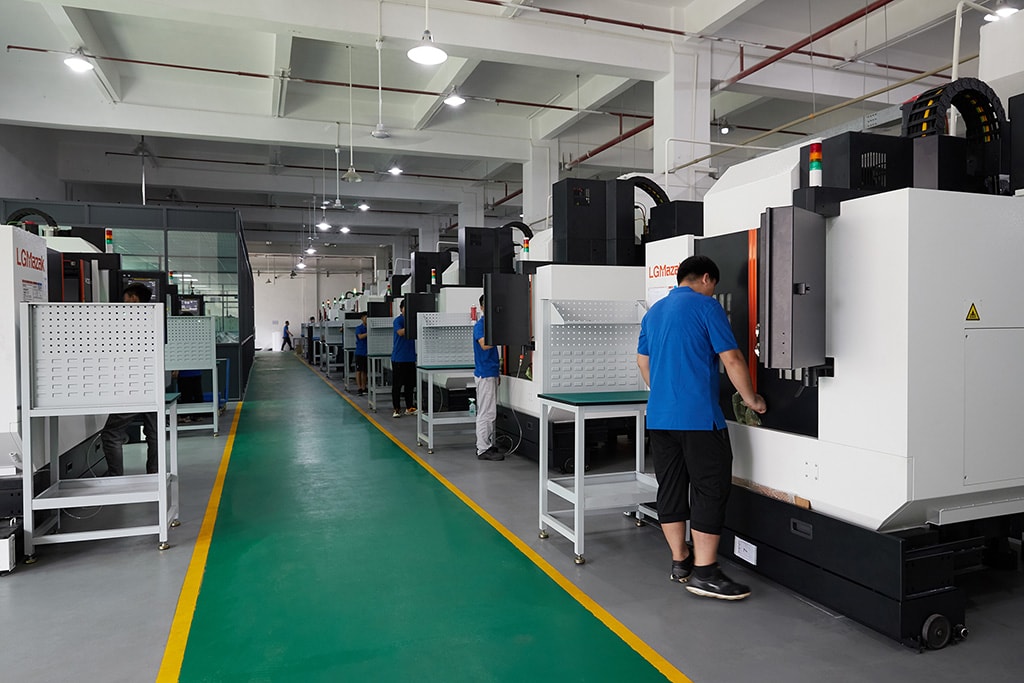
A buyer asking for capability evidence should get a specific answer. The facility behind this guide operates 100+ CNC machines across a 6,800 m2 plant in Dongguan, China, with 100+ staff. The machine list by category:
- 5-axis machining centres (10+) - Mazak VARIAXIS I-600 (510/910/510 mm travel, 12,000 rpm, 22 kW, 71.6 N·m, 30-tool BT40) and Mazak INTEGREX I-250H S (B-axis 0.0001°, 24 kW, 124 N·m, 38-tool HSK-A63). Matched to compound-angle parts, single-setup multi-face prismatic work, and aerospace fittings where datum transfer loss is unacceptable.
- 3-axis / 4-axis machining centres (50+) - Brother SPEEDIO S500Z2N / S700Z2N (10,000 rpm, 14/21-tool ATC, 0.7 s tool-to-tool, Z-axis 2.2 G) and Mazak VCE-430A L / VCE-570C L (10,000 rpm, 118 N·m, 24-tool ATC). Matched to prismatic parts, plates, brackets, housings.
- Over 100 machines on one floor — Mazak / Brother / Tsugami / Star / Citizen class across 6,800 m², with 50+ 3-axis, 20+ 4-axis, 20+ 5-axis, 25+ lathes, 7+ grinders and 20+ inspection instruments.
- Measured, not claimed: ±0.002 mm, verified on Hexagon CMMs. Per-characteristic capability is Ppk ≥ 1.67 initial and Cpk ≥ 1.33 production (≥ 1.33 general). Reports name the feature, band, sample size, sigma method and window.
- Three certificates — ISO 9001:2015, IATF 16949:2016 (design excluded) and ISO 14001:2015, all held by Dongguan Zhuohang Ltd, the entity that invoices you.
- Order terms: MOQ 1 piece, lead times of roughly 3 / 7 / 30 days depending on complexity.
- Machine highlights - VARIAXIS I-600: one-setup multi-face 5-axis + MAZA-CHECK auto-calibration; INTEGREX I-250H S: DONE-IN-ONE mill-turn, B-axis 0.0001° + Ai thermal shield; SPEEDIO S500Z2N / S700Z2N: Z-axis 2.2 G + 0.7 s ATC; Swiss-type: guide-bush switchable + 0.1 µm resolution.
Tolerance bands held: ±0.003 mm on CNC milling, ±0.002 mm on CNC turning, ±0.002 mm on precision grinding and wire EDM. Capability indices: Ppk >= 1.67 initial on key characteristics; Cpk >= 1.33 ongoing in production.
Certifications: ISO 9001:2015 (116024/A/0001/UK/En), IATF 16949:2016 (131941/A/0001/SM/En, design clause 8.3 excluded - disclosed openly), ISO 14001:2015 (116024/B/0001/UK/En). Certificates are issued to Dongguan Zhuohang Ltd (USCC 91441900MA4UWT6X39, established 2005).
Service area: Austria, Belgium, the Czech Republic, Denmark, France, Germany, Greece, Hungary, Ireland, Italy, the Netherlands, Spain, Sweden and the United Kingdom in Europe; Brazil, Canada, Mexico and the United States in the Americas; China, Israel, Japan, Singapore and Sri Lanka in Asia; Australia and New Zealand in Oceania; and South Africa in Africa. Based in China, serving customers worldwide.
Contact: Felipe Iglesias, [email protected], +86 13126536955.
Ready to machine your parts?
Send your drawing to [email protected] or call +86 13126536955 for a quote.
Frequently Asked Questions
What decides a CNC lead time?
In short, Lead time is set by the number of process steps a part needs, plus the queue time those steps wait in. Simple parts with few operations ship fast; complex parts running 10–20 steps, or with surface finishing, take longer.
How fast can I get a prototype?
Simple parts ship in about 3 days, standard parts in about 7, and complex parts — or those with surface finishing — in about 30. The tier is set by the part's complexity, not by a blanket promise.
What tolerances can you hold?
In short, ±0.003 mm on CNC milling, ±0.002 mm on CNC turning and ±0.002 mm for precision grinding, verified on Hexagon CMMs. On a representative length characteristic of 76.1–76.5 mm, the SPC record shows Cpk = 1.851 (one characteristic on one part, not a blanket capability claim) against an initial-study target of Ppk ≥ 1.67.
How does capacity shorten my lead time?
a floor of 100-plus machines across 6,800 m² let a job be routed to the first open machine that fits it, and a demand spike does not stall the work. A real plant schedules; a small shop queues.
What is the minimum order quantity?
The MOQ is 1 piece, so you can validate a design with a single prototype before committing to volume, and the same plant scales from prototype to production without re-qualification.
What slows a lead time down?
Surface finishing, heat treatment, and design changes mid-order all add process steps or restart the clock. Knowing these up front — and stating finish in the RFQ — is how you keep a schedule honest.
How do I plan a prototyping-to-production ramp?
Plan three phases on one floor: a prototype at one piece, a pilot at low volume, then production at volume. The same machines run all three, so the process that validated the prototype is the process that scales.
Can I get a part fast without sacrificing quality?
Yes — speed and quality are both decided by process control. A part that holds tolerance on the first pass ships fast; one that scraps and reworks ships slow. Ppk ≥ 1.67 at the initial study on key characteristics is what fast-and-right looks like measured.
How does setup count map to the tiers?
In short, Setups drive the tier. One setup with no finishing sits in the ~3-day tier; three to five setups sit in ~7 days; more setups, or any finishing or heat treatment, push the part to ~30 days.
What does a tight tolerance add to the schedule?
In short, A tight tolerance forces a slower process and a verification step. A loose callout machines in one pass; ±0.003 mm (milling) / ±0.002 mm (turning) adds a CMM check; ±0.002 mm adds a grinding setup and finish pass.
How does surface finish push a part into the 30-day tier?
Anodizing, plating, or coating adds an outside process step and queue time, which moves a part into the longest tier. A machined-only Ra 1.6 µm finish stays in a shorter tier. Specify finish in the RFQ so the tier is quoted correctly.
How does material choice affect machining time?
Material machinability sets cutting speed and tool wear. Aluminum cuts fast; stainless and alloy steel cut slower and wear tools faster, which adds machine time. The material also sets whether heat treatment is needed after machining.
What is DFM and how does it shorten lead time?
In short, Design for manufacturability removes process steps before the first cut. Practical rules — an internal radius at least a third of the pocket depth, a hole depth under about four to five diameters, and a wall thick enough not to deflect — keep a part in a faster tier.
What are FOB and DDP and how do they affect the schedule?
In short, Incoterms define where cost and risk transfer between buyer and seller. FOB transfers risk at the port of loading; DDP has the seller clear import and deliver to your door.
Do you use MIL-STD-105E or ANSI/ASQ Z1.4 sampling inspection?
In short, MIL-STD-105E is the U.S. military sampling inspection standard published in 1989; it specifies acceptable quality limit (AQL) sampling plans for lot-by-lot inspection.
Standards referenced on this page
- ASTM B211/B211M-19 — Standard Specification for Aluminum-Alloy Rolled or Cold Finished Bar, Rod, and Wire
- ASTM A276/A276M-17 — Standard Specification for Stainless Steel Bars and Shapes
- ISO 9001 — Quality management systems — Requirements